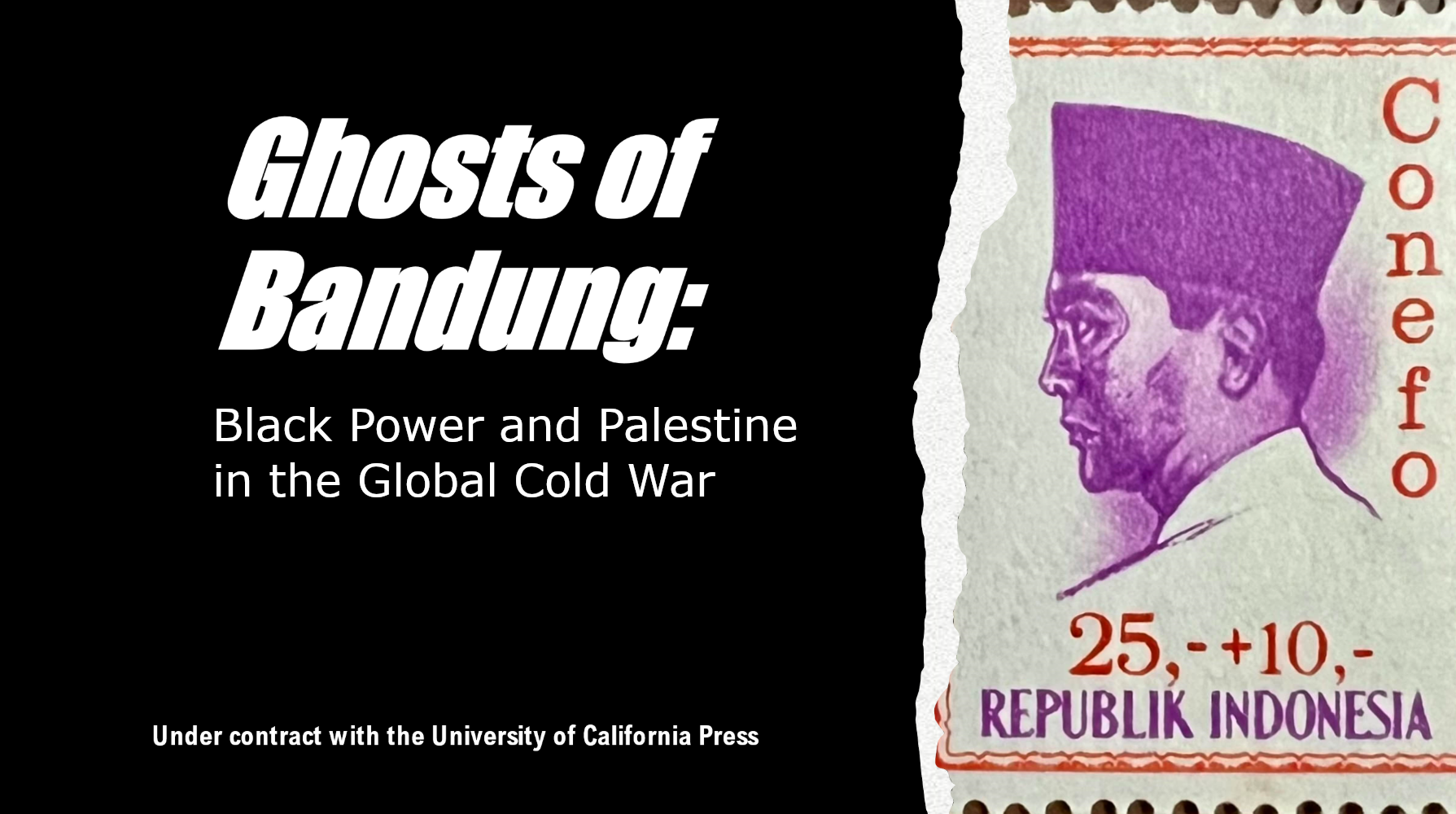
Image: A stamp printed by the Government of Indonesia promoting CONEFO -- Sukarno's proposed alternative to the United Nations -- circa 1965
In September 1969, high-ranking officials in the CIA produced a “Memorandum for the Record” to prepare for their daily briefing with President Nixon. The agents reported that Black Panther-in-exile Eldridge Cleaver had “appeared in Panmunjom, where he is agitating for a number of things including a free Palestine.” Most importantly, the document “noted General Bonesteel’s concern.” Charles Bonesteel was commander of the U.S. Forces Korea – one of the most important military positions in the Pacific theatre. For Cleaver to draw the ire of high-ranking CIA officials and military commanders indicated a genuine fear of Black radicalism’s mobility at the highest levels. His singling out of Cleaver’s call for a “Free Palestine” suggests that Black American engagement with the Palestinian Revolution was of particular concern.
Ghosts of Bandung: Black Power and Palestine in the Global Cold War sets out to contextualize and reevaluate the way Cold War solidarities operated across space and time through the lens of Afro-Arab internationalism. Rooted in understudied English and Arabic archives, the book advances three major arguments. First, it demonstrates that the Palestinian Revolution was a touchstone separating a global Black Power movement from a domestic Civil Rights agenda. This includes unearthing understudied Black internationalist figures and adding Palestinian voices – based on archival research in Arabic – to discussions of Afro-Arab solidarities. Many of these examples predate the traditionally cited origin point of the 1967 June War. Second, the book shows that Afro-Arab solidarities generated concern at the highest levels of state intelligence. It moves beyond simple celebrations of solidarity by analyzing the contradictions, constraints, and sabotage that all internationalist movements – and especially the Black and Palestinian revolutions – were forced to navigate. Lastly, it argues that the fates of the Black and Palestinian Revolutions were intimately bound through the rise and fall of a larger Third World political project. Their trajectories illuminate how anticolonial infrastructure in the Global South was eroded after 1965 – precisely the point at which the Black and Palestinian Revolutions emerged onto the scene as global phenomena.
By tracing the rise and fall of the “Bandung Spirit” and its various permutations, Ghosts of Bandung situates the year 1965 – and the destruction of the Sukarno’s globally ambitious CONEFO project – as a critical flashpoint in the story. As readers move through the chapters, a broader narrative is weaved about the fate of the Global South, including the building and eventual collapse of the anticolonial infrastructure which animated the Third World political project. Black and Palestinian revolutionaries were certainly participants in and aided by this project – at moments becoming the most visible manifestations of it – but both movements were also limited by the timing of their entrance onto the scene and the objective realities after the momentous defeats of 1965.
Coming Late 2026!
 Derek Ide, Ph.D.